
Here’s something nobody tells you when you’re diagnosed with PCOS: everyone’s version looks different. Your friend with PCOS has irregular periods and acne. You’re struggling with weight gain and excess hair growth. You’re both told you have the same condition, but your day-to-day realities couldn’t be more different. So what exactly is PCOS - and why does it seem like such a moving target?
Welcome to PCOS Basics series - a guide to Polycystic Ovary Syndrome. Whether you’ve just been diagnosed, think you might have PCOS, or simply want to understand it better, this series walks you through diagnosis, symptoms, treatment, and long-term health so you can feel informed and in control.
P.S. If you’d like to dive deeper, the post contains multiple links to research papers. (check out my guide on how to read a research paper).
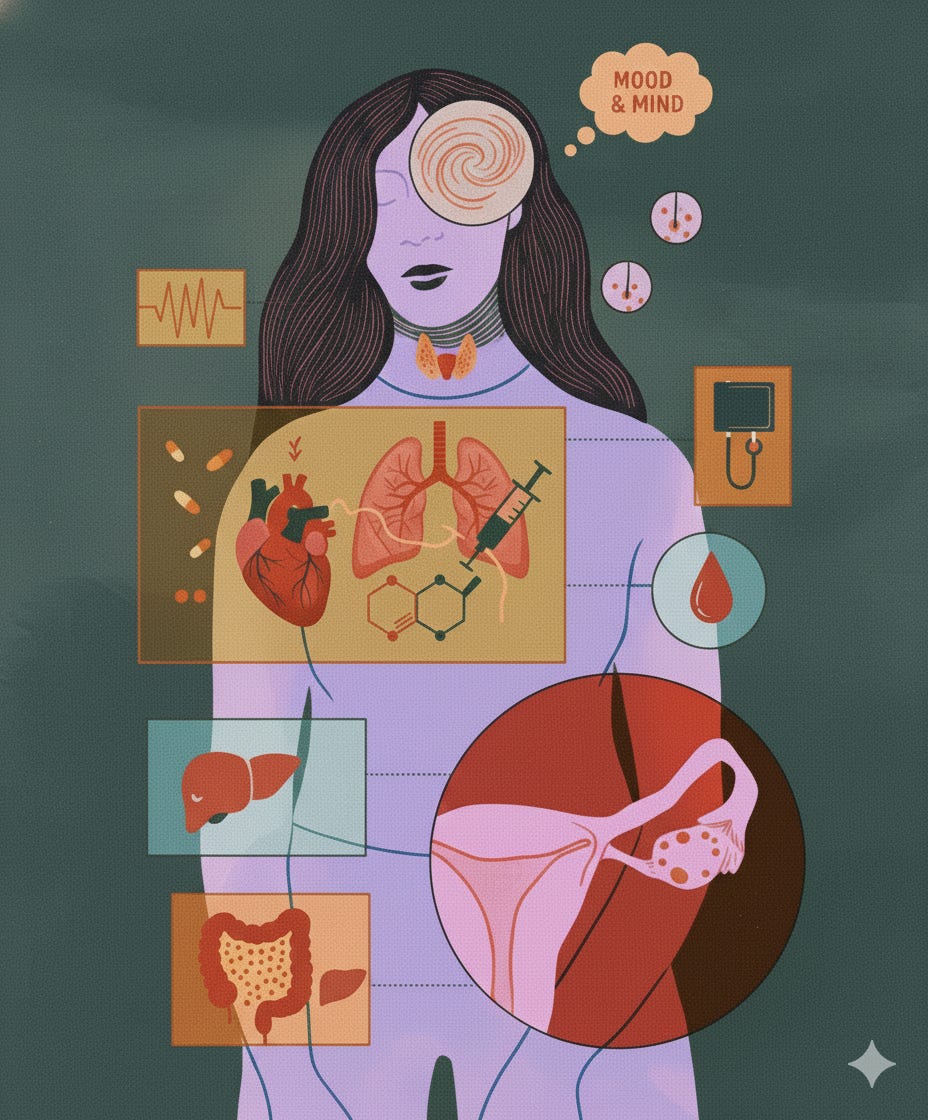
Why PCOS is Called a Syndrome
The word syndrome is key to understanding PCOS. Unlike a disease with a single known cause (like the flu, which is caused by a virus), a syndrome is a collection of symptoms that tend to occur together, even when we don’t fully understand why.
PCOS isn’t one thing going wrong in your body - it’s multiple systems that aren’t communicating properly. Think of it like a group project where everyone’s working from different instructions. Your hormones, your metabolism, and your ovaries are all involved, and they’re all affecting each other in complex ways.
This is why there’s no single “PCOS test.” Instead, doctors diagnose PCOS by looking at a combination of features. I break down the diagnostic criteria in detail in my previous PCOS Basics post, but here’s the TLDR: you need two out of three - high androgens, irregular ovulation, or polycystic ovaries on ultrasound.

What Is Actually Happening in Your Body
At its core, PCOS involves a vicious cycle of hormonal and metabolic dysfunction. Here’s what’s going wrong.
The Hormone Disruption
Your hypothalamus and pituitary gland (in your brain) normally send carefully timed signals to your ovaries to control your menstrual cycle. In PCOS, this communication system is disrupted. Your pituitary releases too much luteinising hormone (LH) relative to follicle-stimulating hormone (FSH), which throws off the whole process.
This hormonal imbalance means your ovaries produce too many androgens -hormones like testosterone that are typically thought of as “male” hormones but are naturally present in women too. These excess androgens can cause symptoms like acne, excess facial or body hair, and scalp hair loss.

The Insulin Problem
About 70% of women with PCOS have insulin resistance, meaning their cells don’t respond properly to insulin. When this happens, your pancreas pumps out even more insulin to compensate (hyperinsulinemia).
Here’s where it gets worse: excess insulin actually signals your ovaries to make even more androgens. It also suppresses a protein called sex hormone-binding globulin (SHBG), which normally keeps androgens in check. With less SHBG around, you have more “free” androgens circulating in your bloodstream, amplifying symptoms.
The Ovarian Changes
All of this hormonal chaos affects your ovaries directly. Follicles (the fluid-filled sacs that contain eggs) start developing but get stuck at an early stage instead of maturing properly. This creates the characteristic “string of pearls” appearance on ultrasound - multiple small follicles arrested in development around the edge of the ovary.
Because follicles aren’t maturing properly, ovulation often doesn’t happen, leading to irregular or absent periods. When you don’t ovulate regularly, you also don’t produce enough progesterone, which can cause other issues down the line.
Why Symptoms Vary So Much Between People
This is where PCOS gets really complex. To be diagnosed, you need to meet 2 out of 3 criteria, which creates four different combinations (aka phenotypes) of PCOS:
Phenotype A (Full PCOS): High androgens + irregular ovulation + polycystic ovaries
Phenotype B (Non-PCO PCOS): High androgens + irregular ovulation (but normal-looking ovaries)
Phenotype C (Ovulatory PCOS): High androgens + polycystic ovaries (but regular ovulation)
Phenotype D (Non-hyperandrogenic PCOS): Irregular ovulation + polycystic ovaries (but normal androgen levels)
Research shows these aren’t just arbitrary categories - they represent genuinely different presentations with different metabolic risks and genetic underpinnings.¹²
But It Gets Even More Complex…
Beyond these four official phenotypes, there’s enormous variation based on:
Genetics: PCOS runs in families, but the specific genes involved are still being identified. Recent research suggests there may be distinct genetic subtypes with different underlying mechanisms. This means your PCOS might genuinely be different from someone else’s at a biological level.
Ethnicity: PCOS presents differently across ethnic groups. East Asian women with PCOS tend to have less severe hirsutism and lower rates of obesity compared to women of European descent, while South Asian, Middle Eastern, and Hispanic women often experience more severe hirsutism and metabolic dysfunction.
Body Weight: Obesity amplifies many PCOS symptoms, particularly insulin resistance and metabolic problems. But about 30% of women with PCOS are lean, and they can have a significantly different clinical picture.
Age: PCOS symptoms can change throughout your life. They often emerge or worsen during puberty, may improve with lifestyle changes or treatment during your reproductive years, and shift again as you approach menopause.
The Bottom Line
PCOS is complex by nature. It’s not that doctors don’t know what they’re talking about or that you’re a medical mystery - it’s that PCOS is genuinely a heterogeneous condition with multiple subtypes and presentations.
Understanding that PCOS is a syndrome - a cluster of related symptoms with multiple underlying causes - can help make sense of why your experience might be so different from someone else’s, why treatment approaches need to be individualised, and why there’s no one-size-fits-all solution.

The good news? Research is increasingly recognising these different subtypes and working toward more personalised approaches to diagnosis and treatment. The more we understand about PCOS heterogeneity, the better we can tailor management to each person’s specific presentation.
Please give this post a ❤️ if you found it valuable!